This article contains affiliate links. If you buy through them, we may earn a commission at no extra cost to you. Learn more.
The Breakdown
Buffering, legality, price — the premium IPTV service conversation is full of half-truths. Here's what the evidence actually says, and how to choose without the guesswork.
In Brief
- Buffering is a provider infrastructure problem, not an IPTV inevitability — test at peak hours before paying.
- Price alone doesn't determine legitimacy; licensing transparency and payment terms are the real signals.
- Multi-screen household plans are standard, but concurrent stream limits vary — read the terms carefully.
- A yearly subscription delivers the best value, but only after a successful trial and with a traceable payment method.
On this page
- Why Misconceptions Damage Results
- Myth 1: All Premium IPTV Services Are the Same
- Myth 2: Buffering Is Inevitable with IPTV
- Myth 3: Cheap Means Illegal or Low Quality
- Myth 4: IPTV Is Just a Cheaper Cable Clone
- Myth 5: Setup Is Complicated and Single-Device Only
- What Actually Works in a Premium IPTV Service
- Popular Belief vs Reality
- Frequently Asked Questions
The premium IPTV service market is full of conflicting advice. Some say you need to spend more for reliable streams; others insist every provider is a gamble. Neither is true. The evidence points to a simpler conclusion: most problems come from choosing a provider for the wrong reasons — channel count, price alone, or a friend's bad experience — while ignoring the factors that actually determine quality: infrastructure, licensing transparency, and device support.
This article separates the myths from the documented reality. You'll learn which claims to ignore, which signals actually predict a reliable subscription, and how to evaluate a provider in under an hour. No hype, no invented statistics — just the patterns that hold up under scrutiny.
Why Misconceptions Damage Results
The damage happens before you even subscribe. People buy based on channel count alone, or they avoid IPTV entirely because a friend once had a bad experience. Both reactions miss the point.
A premium IPTV service is only as good as its infrastructure, licensing arrangements, and device support. When you evaluate those three things properly, most of the horror stories you read online become avoidable. When you don't, even the cheapest subscription feels expensive.
The five myths below are the ones we see repeated most often in forums, review comments, and YouTube videos. Each one contains a kernel of truth — which is why it survives. But each one also leads to poor decisions.
Myth 1: All Premium IPTV Services Are the Same
The kernel of truth: most IPTV apps look similar. The interface is a channel list, an electronic program guide (EPG), and a search bar. So if the interface looks the same, the service must be the same, right?
No. The real differences sit underneath the interface. Server infrastructure, content delivery networks, codec support, EPG accuracy, and account management all vary dramatically between providers. A service that routes streams through overloaded servers will buffer at peak times. A service with proper CDN distribution can hold a stable stream even during a major football match.
The quality of the channel list matters more than its length. A premium IPTV service with catchup features, for example, gives you a 7-day rewind on most channels — that's not a cosmetic extra, it changes how you watch. Similarly, exclusive premium IPTV European channels are often the deciding factor for expats who want home-country news and sport in the original language.
The practical takeaway: judge a service by its underlying infrastructure and features, not by the skin on top.
Myth 2: Buffering Is Inevitable with IPTV
This is the most damaging myth of all. People tolerate buffering because they believe it's part of the IPTV experience. It isn't.
Buffering has three main causes: insufficient bandwidth on your side, weak hardware decoding on your device, and server-side congestion on the provider's side. Only the first two are your responsibility. The third is entirely the provider's.
A premium IPTV service no buffering promise is realistic when the provider runs a distributed server network and actively monitors load. That's why uptime figures matter. Trusted IPTV providers with 99.9% uptime publish their status and offer trial periods that let you test at the times you actually watch — usually weekday evenings and weekend afternoons.
If a service buffers during the trial, it will buffer after you pay. That's not speculation; it's the most reliable predictor we have.
A service that buffers during the trial will buffer after you pay — that is the most reliable predictor we have.
Myth 3: Cheap Means Illegal or Low Quality
Let's be precise here. There are indeed unlicensed IPTV services that sell access to stolen streams, and they tend to be cheap. But the reverse — that all cheap IPTV is illegal — does not follow.
Legally licensed premium IPTV providers exist across a wide price range. Some license content for specific regions only, which lowers their costs. Others operate in markets where content licensing is less expensive. The result is that an affordable premium IPTV under $5 can be completely legitimate in the right context.
The real test is transparency. A licensed provider will clarify what's included, which regions the license covers, and how you can use the service. Vague marketing, anonymous payment demands, and channel lists that look too good to be true are the actual red flags.
Price is a signal, not a verdict. Judge the service on its terms, its licensing disclosures, and its willingness to offer a trial.
Myth 4: IPTV Is Just a Cheaper Cable Clone
People assume IPTV simply replicates the cable package — the same channels, the same schedule, the same experience. That assumption leads them to compare prices and nothing else.
The reality is that a premium IPTV service operates differently from cable in ways that matter. Catchup TV, multi-screen viewing, and device flexibility are core features, not add-ons. A premium IPTV multi screen household plan, for example, lets different family members watch different channels on different devices at the same time. That's not something most cable subscriptions handle gracefully.
There's also the content angle. Exclusive premium IPTV European channels are a genuine reason people switch — they want access to regional sports leagues, local news, and cultural programming that domestic cable packages simply don't carry.
When you evaluate IPTV as a cable replacement, you're applying the wrong mental model. It's a different product, and it should be judged on its own terms.
Myth 5: Setup Is Complicated and Single-Device Only
The kernel of truth: the first IPTV setup can feel fiddly if you're using an unofficial app and manually entering server URLs. But that's the old way.
Modern providers offer a premium IPTV firestick optimized setup that takes a few minutes: install the app, enter your credentials, and the EPG populates automatically. Some providers even send one-click setup links that configure the device for you.
Device support is also wider than most people assume. A good service works on Android TV, Fire TV, iOS, Android phones, smart TVs, and web browsers. The question isn't whether it supports your device — it's whether the provider tests and optimizes for that device. That's the difference between a service that "works" and one that works well.
Pros
- Significant cost savings over cable, especially on yearly plans
- Multi-screen support for households with different viewing habits
- Catchup features and international channel access in one interface
- Works across Firestick, smart TVs, phones, and tablets
Cons
- Quality varies widely between providers — research is essential
- Licensing status can be hard to verify without asking directly
- Requires a stable internet connection (at least 25 Mbps for HD)
- Customer support responsiveness is inconsistent across the industry
What Actually Works in a Premium IPTV Service
After looking at how providers operate and what experienced users consistently report, a few patterns stand out. These are the criteria that separate good decisions from lucky ones.
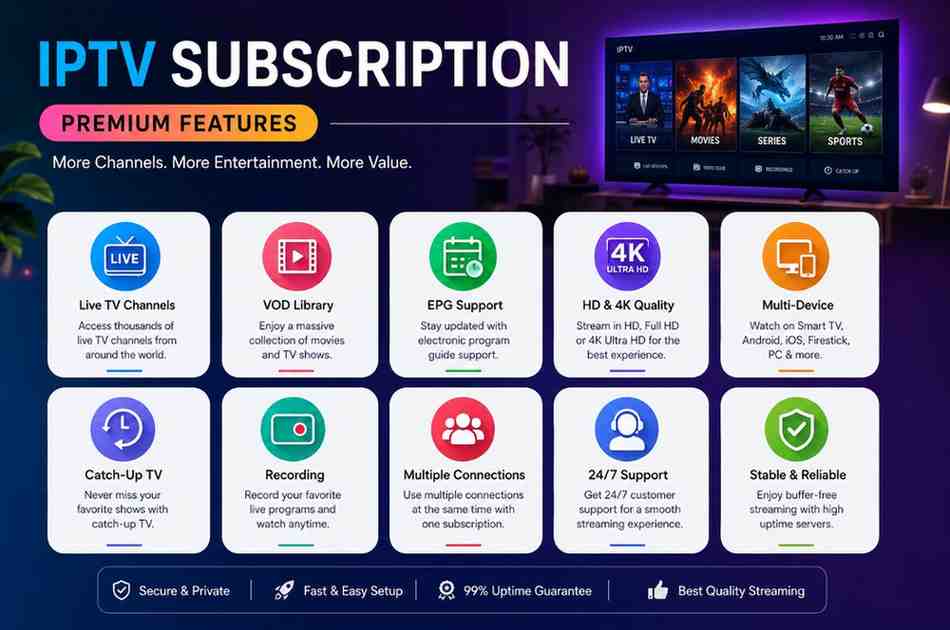
- Start with a trial — always. A 24-hour or 7-day trial tells you more than any review. Test at peak times, on the device you'll actually use, and with the channels you actually watch.
- Check the EPG quality. A detailed, accurate electronic program guide is a sign of a professionally managed service. If the guide is empty or wrong, the service is probably maintained on autopilot.
- Verify multi-screen terms. If you need a premium IPTV multi screen household plan, confirm how many concurrent streams are allowed and whether they count across devices or per profile.
- Look for catchup and recording. A premium IPTV service with catchup features is far more useful than one without, especially if your schedule doesn't align with live broadcast times.
- Assess the yearly value honestly. A reliable premium IPTV yearly subscription usually costs less than two months of cable. But only commit to a year after a successful trial, and pay with a method that gives you recourse.
- Confirm device optimization. For Firestick users, a premium IPTV firestick optimized setup is not a gimmick — it affects startup speed, EPG loading, and playback stability.
One more pattern worth noting: the best-value high-definition IPTV subscriptions aren't necessarily the cheapest or the most expensive. They're the ones that match your actual viewing needs — the right channel set, the right device support, and the right stream stability — without charging for extras you'll never use.
Popular Belief vs Reality
| Popular Belief | Reality |
|---|---|
| All IPTV services are the same under the interface | Infrastructure, CDN, and EPG quality vary dramatically between providers |
| Buffering is part of the IPTV experience | Buffering is a provider infrastructure issue; distributed servers solve it |
| Cheap IPTV is always illegal or low quality | Legally licensed providers operate at various price points; transparency is the real test |
| IPTV is just a cheaper cable clone | Catchup, multi-screen, and international content make it a genuinely different product |
| Setup is complicated and single-device | Modern providers offer one-click Firestick setup and multi-device support |
| More channels means a better service | A maintained 5,000-channel list beats a bloated, unmanaged 20,000-channel list |
| Yearly subscriptions are too risky | They're the best value when preceded by a trial and backed by transparent terms |
Where to Buy
See the current price, available bundles, and shipping options on the official page.
How to Apply This Without Overthinking
The practical path is clear: shortlist providers that offer a trial, test them at peak times, and only then commit. If you want a concrete starting point, the premium iptv service covered in this article includes the features discussed above — multi-screen support, catchup, and Firestick optimization. But the trial is still the final judge.
Remember the pattern: infrastructure determines buffering, transparency determines trust, and device support determines daily satisfaction. Everything else is marketing.
The Bottom Line
A premium IPTV service is worth your money when you evaluate it on infrastructure, licensing transparency, and device support — not on channel count or price alone. Start with a trial, test at peak times, and only then commit to a yearly plan.
Get Access NowThis link goes to the seller's official checkout. If you purchase through it, we may earn a commission at no additional cost to you. Our assessment is written independently of that arrangement.
Frequently Asked Questions
Does a premium IPTV service with no buffering really exist?
Yes, but only when the provider has proper infrastructure. Buffering is usually caused by server congestion on the provider's side, not by your internet connection. A provider with distributed servers and active load monitoring can deliver buffer-free streams during peak hours. Always test during the trial period at the times you actually watch — weekday evenings and weekend afternoons are the most revealing.
Is there an affordable premium IPTV under $5 that works well?
In some markets, yes. Licensing costs vary by region, and some legitimate providers price under $5 because their content licenses are regional rather than global. The key is transparency — a provider that clearly states what's included and offers a trial is more trustworthy than one that just promises everything for a low price. Be especially cautious of providers that require cryptocurrency or untraceable payments.
Are exclusive premium IPTV European channels worth the extra cost?
For expats and multilingual households, absolutely. European channels often include regional sports leagues, local news, and cultural programming that domestic packages don't carry. If you regularly watch content in another language, the ability to access those channels in one interface is a genuine benefit. Check which specific channels are included before subscribing, because "European channels" can mean very different things across providers.
Can a premium IPTV multi screen household plan save me money?
Yes, if your household regularly watches different content at the same time. Instead of paying for multiple cable boxes, a multi-screen IPTV plan lets each person watch on their own device. Just confirm the concurrent stream limit before subscribing, because providers define "multi-screen" differently — some allow 2 simultaneous streams, others allow 4 or more. The savings are real, but only if the plan matches how your household actually watches.
How do I choose a reliable premium IPTV yearly subscription?
Start with a short-term trial, then evaluate EPG accuracy, buffering at peak times, and customer support responsiveness. A provider that performs well during a trial and offers transparent payment terms is the safest bet for a yearly commitment. Avoid providers that only offer anonymous payment methods or that pressure you into long contracts without a trial period. A yearly subscription should always be the second step, never the first.
What are legally licensed premium IPTV providers and how do I find them?
Legally licensed providers secure content distribution rights from rights holders or operate in regions where their content is licensed for streaming. Look for providers that clearly describe their licensing coverage, offer transparent terms, and avoid making unrealistic promises. When in doubt, contact their support team and ask directly about licensing — a legitimate provider will give you a straight answer about which regions and content categories their licenses cover.
What is a premium IPTV Firestick optimized setup?
A Firestick-optimized setup means the provider's app is specifically configured for Amazon Fire TV devices — it launches quickly, loads the EPG reliably, and handles video decoding efficiently. In practice, it means you install the app, enter your credentials, and the channel list populates automatically. No manual server URL entry, no sideloading guesswork. The difference is noticeable in everyday use: faster startup, smoother channel zapping, and fewer playback hiccups.
What does a premium IPTV service with catchup features include?
Catchup lets you rewind or replay programs that aired in the past few days, typically up to 7 days depending on the channel. It's similar to how you'd use a DVR, but the recording happens on the provider's side — you don't need to schedule anything in advance. Not all channels support catchup, so check which ones do before subscribing. This feature is especially valuable for sports fans who miss live games and for households that watch on irregular schedules.
Disclosure: Some links in this article are affiliate links, meaning we may earn a commission if you make a purchase — at no additional cost to you. This does not influence our editorial assessment, which is based on publicly available information about the product.